
Blog
Jyotish in Varanasi: Vedic Astrology Consultation, Kundli & Guidance

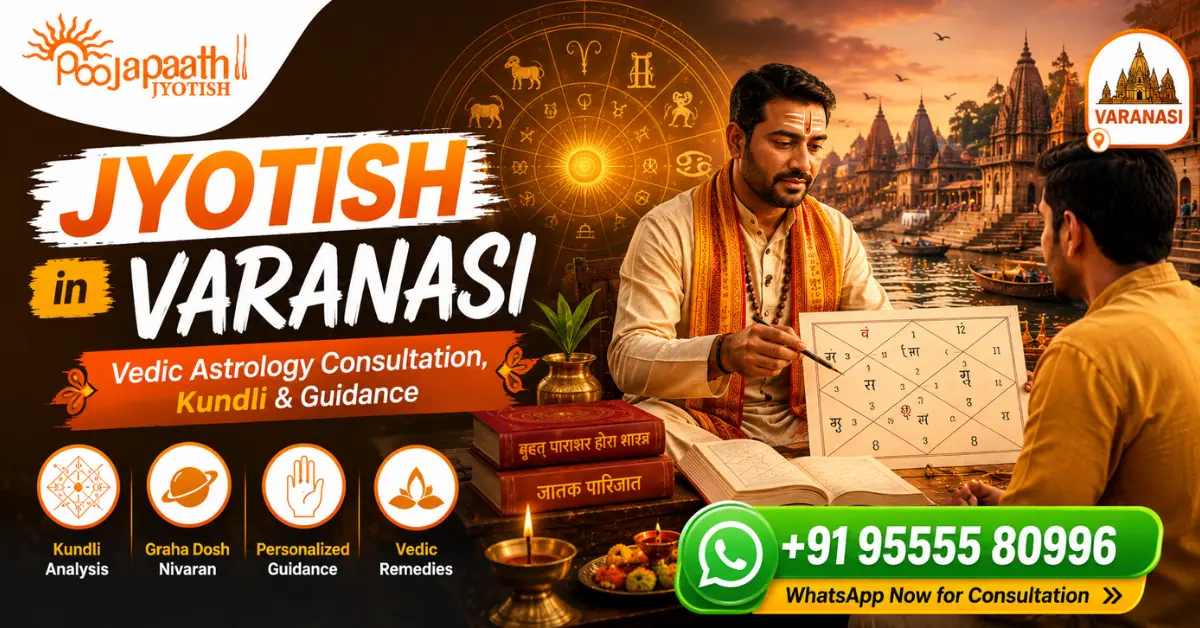
Most people searching for Jyotish in Varanasi are not looking for a daily horoscope. They usually want help understanding something more specific — what their Kundli says about career timing, marriage, education, a business decision, an upcoming Muhurat, or a pattern they keep noticing in their life. Some come with a spiritual question that doesn’t fit neatly into any of these categories.
A proper Vedic astrology consultation should begin with your actual question, not with a dramatic prediction. Before an astrologer even opens your Kundli, they should understand what you are trying to figure out — because a chart reading means very little if it doesn’t connect back to your real concern. This guide explains what Jyotish actually involves, how a consultation typically works, and how to prepare so that the session is genuinely useful to you.
| Quick Answer: What Is Jyotish Consultation? • Jyotish is the traditional Vedic system of studying planetary positions and their relationship to a person’s life — more detailed than a Sun-sign horoscope • A Kundli is your personal birth chart, built from your exact birth date, time and place • A consultation typically needs your birth date, time, birthplace, and a specific question • It normally covers planetary placements, houses (Bhava), and relevant periods (Dasha) connected to your concern • Birth time matters because it determines your Lagna (ascendant) and house positions • A responsible practitioner explains their reasoning rather than only stating conclusions • Astrology should be treated as guidance on tendencies and timing, not a guarantee of a specific outcome |
What Is Jyotish? Understanding Vedic Astrology
Jyotish is the Sanskrit term for the traditional Indian system of astrology, sometimes translated as the “science of light.” It is built around the idea that the position of planets at the moment of birth reflects certain patterns and tendencies in a person’s life. A few core terms come up in almost every Jyotish conversation:
- Kundli — your birth chart, mapping planetary positions at your exact time of birth
- Graha — the nine planetary bodies studied in Vedic astrology
- Rashi — your Moon sign, one of twelve zodiac divisions
- Nakshatra — the lunar constellation your Moon occupies, more precise than the Rashi alone
- Lagna — your ascendant, the sign rising on the eastern horizon at your birth
- Bhava — the twelve houses of the chart, each connected to a different area of life
- Dasha — planetary periods believed to influence the timing of events
- Gochar — the current transit of planets, read against your birth chart
Together, these elements form a far more individual picture than a generic horoscope column, which is why Vedic astrology consultations usually start with a full Kundli rather than just a birth month or Sun sign.
How Does a Vedic Astrology Consultation Work?
While every practitioner works a little differently, a genuine Jyotish consultation generally follows a similar structure:
- Understanding the person’s question — what they actually want clarity on
- Collecting accurate birth details — date, time and place of birth
- Preparing or reviewing the Kundli based on those details
- Studying the planetary placements relevant to the question asked
- Looking at applicable Dasha periods and current transits (Gochar)
- Explaining the observations in plain, understandable language
- Discussing traditional guidance or remedies, where genuinely appropriate
- Allowing space for the person to ask follow-up questions
| Pandit Ji’s View “A good consultation should feel like an explanation, not a performance. If someone leaves more anxious than when they arrived, something has gone wrong — the purpose of Jyotish is to bring clarity, not fear.” |
What Can You Consult a Jyotish About?
A Jyotish consultation can reasonably help with a wide range of questions, though the depth and usefulness depends on how specific your question is:
- Career — general direction, timing considerations for a change, or evaluating an offer
- Marriage — compatibility factors (Guna Milan) and timing-related questions
- Education — areas of natural inclination and planetary influences on focus
- Business — partnership considerations and Muhurat for starting new ventures
- Family matters — general relationship patterns visible in the chart
- General life patterns — recurring themes connected to Dasha periods
- Important decisions — timing considerations for a major choice you’re weighing
- Muhurat — auspicious timing for weddings, Griha Pravesh, and similar events
- Spiritual questions — remedies, Puja recommendations, and related traditional practices
- Kundli interpretation — understanding your own chart in more depth
| An Important Note A Jyotish consultation does not guarantee marriage, wealth, employment, pregnancy, health recovery, or any other specific outcome. For health concerns, Jyotish should never replace qualified medical advice. For major financial decisions, it should not replace professional financial advice either — it can offer perspective, not a substitute for expert guidance. |
| Pandit Ji’s View “I try to understand the exact question before I open anyone’s Kundli. Two people can ask about ‘career’ and mean completely different things — one wants timing for a job change, another wants reassurance about a decision they’ve already made. The chart only becomes useful once I know which one it is.” |
What Is a Kundli and Why Is It Important in Jyotish?
Your Kundli is built from three pieces of information: your birth date, your exact birth time, and your birthplace. From these, a Jyotish calculates your Lagna (ascendant), the position of each planet, the twelve houses (Bhava), your Nakshatra, and your current and upcoming Dasha periods.
Of these, birth time is often the most sensitive. A difference of even a few minutes can shift your Lagna and rearrange the houses, which changes how several parts of the chart are read.
What happens if the birth time is uncertain?
If you are unsure of your exact birth time, say so honestly rather than guessing. A responsible astrologer will discuss this limitation with you directly, and in some traditional practices, may consider birth-time rectification — cross-checking the chart against known life events to narrow down a likely time. This process can improve accuracy, but it does not produce absolute certainty, and a good practitioner will tell you that plainly.
| Pandit Ji’s View “I would rather work with an honest ‘I’m not fully sure of the time’ than a guessed time presented as exact. A chart built on a wrong assumption can lead the whole conversation in the wrong direction.” |
What Should You Prepare Before a Jyotish Consultation?
A little preparation goes a long way toward making your consultation useful. Before your session, try to have ready:
☐ Date of birth
☐ Birth time (as exact as possible)
☐ Birthplace
☐ Specific questions you want addressed
☐ Relevant background information, where it helps (e.g. an approximate date of an earlier life event)
☐ Your existing Kundli, if you already have one prepared
☐ Your preferred consultation format — online or in-person
Coming in with a specific question — “Is this a good time to change jobs?” rather than “tell me my future” — helps the astrologer focus on what actually matters to you, instead of a generic walkthrough of your entire chart.
Online vs In-Person Jyotish Consultation
Both formats can work well. What ultimately matters is the practitioner’s knowledge and how clearly they communicate, not simply whether the session happens on a screen or in person.
| Factor | Online Consultation | In-Person Consultation |
| Convenience | Consult from anywhere, including outside Varanasi | Requires visiting in person |
| Travel | None required | Involves travel time and cost |
| Scheduling | Generally more flexible | Bound by in-person availability |
| Kundli sharing | Shared digitally, discussed over call or screen-share | Reviewed together in physical or printed form |
| Family participation | Multiple members can join from different locations | Easier when the family can travel together |
| Communication | Video, audio or written, as preferred | Face-to-face, which some find more personal |
| Privacy | Conducted from a private space of your choosing | Depends on the consultation setting |
| Accessibility | Useful for NRIs and people in other cities | Best suited to those already in or near Varanasi |
Why Do People Seek Jyotish in Varanasi?
Varanasi, also known as Kashi or Banaras, has a long and well-documented association with Sanskrit learning, traditional religious education, and Vedic practice. Its temples, centres of Sanskrit study, and continuous Panchang and ritual traditions are part of why the city carries a certain depth around Jyotish and related subjects.
This is a meaningful part of the city’s context, but it does not mean every astrologer based in Varanasi is automatically authentic or more accurate than one elsewhere. The tradition provides a backdrop; the individual practitioner’s knowledge, transparency and communication still need to be evaluated on their own terms.
How to Identify a Genuine Vedic Jyotish
Without repeating a full evaluation checklist here, a few signs are worth watching for:
- Clear explanations of the reasoning behind observations, not just conclusions
- A transparent consultation process — timing, format and approach explained upfront
- Genuine grounding in traditional Vedic Jyotish, not a generic script
- Willingness to answer your questions, rather than discouraging them
- No fear-based selling or dramatic warnings used to push a decision
- No guaranteed predictions or “100% accurate” claims
- Respect for your privacy and personal circumstances
- Remedies, where suggested, explained clearly rather than presented as compulsory
For a more detailed, step-by-step breakdown of what to check before booking, see our guide on how to choose a trusted astrologer in Varanasi.
Our Approach to Vedic Jyotish Consultation
At Pooja Paath Jyotish, our approach to a consultation is built around a few consistent principles:
- We start by listening to your actual concern before looking at anything else
- We work carefully with the birth details you provide — date, time and place
- We explain the Kundli in plain language, connecting it back to your original question
- We discuss relevant Vedic concepts — Dasha, Gochar, Bhava — as they apply to you specifically
- We answer your questions during the session rather than rushing through a script
- We offer traditional guidance, including remedies, where genuinely appropriate — always as an option, not a requirement
- We avoid creating unnecessary fear or urgency around any observation
| Pandit Ji’s View “If I suggest a remedy, I explain why — what it’s meant to support and why it’s traditionally used for that purpose. A remedy someone doesn’t understand isn’t really guidance, it’s just an instruction, and that’s not how this tradition is meant to work.” |
Can You Consult a Jyotish Online?
Yes, and it works well for many people, especially those living outside Varanasi who still want a Vedic-trained perspective. A typical online consultation follows steps like these:
- Contact us to share what you’d like to discuss
- Share your birth details — date, time and place of birth
- Confirm your appointment time and format
- Share your existing Kundli, if you have one, or have it prepared
- Join the video or phone consultation at the scheduled time
- Ask your questions openly during the session
- Discuss the guidance offered, including any suggested remedies
This makes it possible to consult a Varanasi-based Jyotish whether you live in another Indian city or outside India altogether.
Jyotish, Muhurat and Vedic Puja
Jyotish and Puja are closely related but not the same service. A Jyotish consultation is primarily about understanding your Kundli and the timing or tendencies it points to. That understanding, however, often connects to practical decisions — particularly around Muhurat, the traditional practice of selecting an auspicious time for an important event.
You might consult a Jyotish before:
- Selecting a Muhurat for a wedding, Griha Pravesh, or business launch
- Planning the timing of a Samskara, such as Mundan or Naamkaran
- Understanding traditional timing considerations for a Puja
- Discussing a traditional remedy connected to your Kundli
If your consultation leads to booking an actual ceremony, our Vedic Puja and Pandit booking guide in Varanasi covers that process separately, and you can also explore online Pandit Ji booking directly. If your question relates specifically to your home or office rather than timing, a Vastu consultation may be more relevant than a Jyotish session.
Frequently Asked Questions
What is Jyotish?
Jyotish is the traditional Vedic system of studying planetary positions and their relationship to a person’s life through a birth chart called a Kundli. It looks at timing, tendencies and patterns rather than offering a single fixed prediction, and forms part of India’s broader Vedic knowledge tradition.
What is the difference between Jyotish and astrology?
“Astrology” is often used loosely for daily horoscope columns based only on a Sun or Moon sign. Jyotish specifically refers to the Vedic system, which studies a complete birth chart built from your exact birth date, time and place, including planetary periods (Dasha) and houses (Bhava) unique to you.
What information is needed for a Kundli consultation?
A Kundli consultation typically needs your date of birth, exact time of birth, and place of birth. Sharing a clear, specific question also helps the consultation stay focused on what matters to you, rather than a generic run-through of the entire chart.
What can I ask a Jyotish?
You can ask about career direction, marriage and relationships, education, business decisions, family matters, important life decisions, Muhurat for auspicious timing, and general life patterns. A Jyotish can also help interpret your Kundli and discuss traditional remedies where relevant.
Can I consult a Jyotish online?
Yes. An online consultation typically involves sharing your birth details in advance, confirming an appointment, and then discussing your Kundli over a video or phone call. This makes it possible to consult a Varanasi-based Jyotish from anywhere.
Why is birth time important in Vedic astrology?
Birth time determines your Lagna (ascendant) and the placement of the twelve houses in your Kundli. Even a difference of a few minutes can shift these positions, which is why an accurate birth time leads to a more precise and relevant reading.
How long does a Jyotish consultation take?
This varies depending on the practitioner and the depth of the question, but most consultations range from around thirty minutes to an hour. It is reasonable to confirm the expected duration before booking.
How do I choose a trusted Jyotish in Varanasi?
Look for clear explanations, a transparent process, and a practitioner who avoids fear-based selling or guaranteed predictions. For a more detailed breakdown of what to check, see our guide on how to choose a trusted astrologer in Varanasi.
Can Jyotish help with Muhurat?
Yes. Muhurat, or auspicious timing, is a traditional application of Jyotish often used for weddings, Griha Pravesh, business launches and other significant events. It is a related but distinct use of the same birth-chart knowledge.
Is a Jyotish prediction guaranteed?
No. A responsible Jyotish treats predictions as guidance on tendencies and probable timing, not as guaranteed outcomes. Be cautious of anyone who promises certain results or uses fear to push a decision.
Finding the Right Jyotish in Varanasi
Getting real value from a Jyotish consultation comes down to a few consistent habits: understand what you actually want clarity on, check the practitioner’s consultation approach before booking, prepare accurate birth details, ask questions during the session, and stay cautious of anyone offering guaranteed predictions. Choose transparency over fear, and treat the guidance you receive as one useful input among several — not a final verdict.
If you are looking for a Vedic Jyotish consultation in Varanasi, you can contact Pooja Paath Jyotish to discuss your requirement and available consultation options.
Related Posts

Best Astrologer in Varanasi: How to Choose a Trusted Vedic Jyotish
-
Posted by
 Pooja Paath Jyotish